The Comune Runs Your Life in Italy
By Caesar Sedek ·
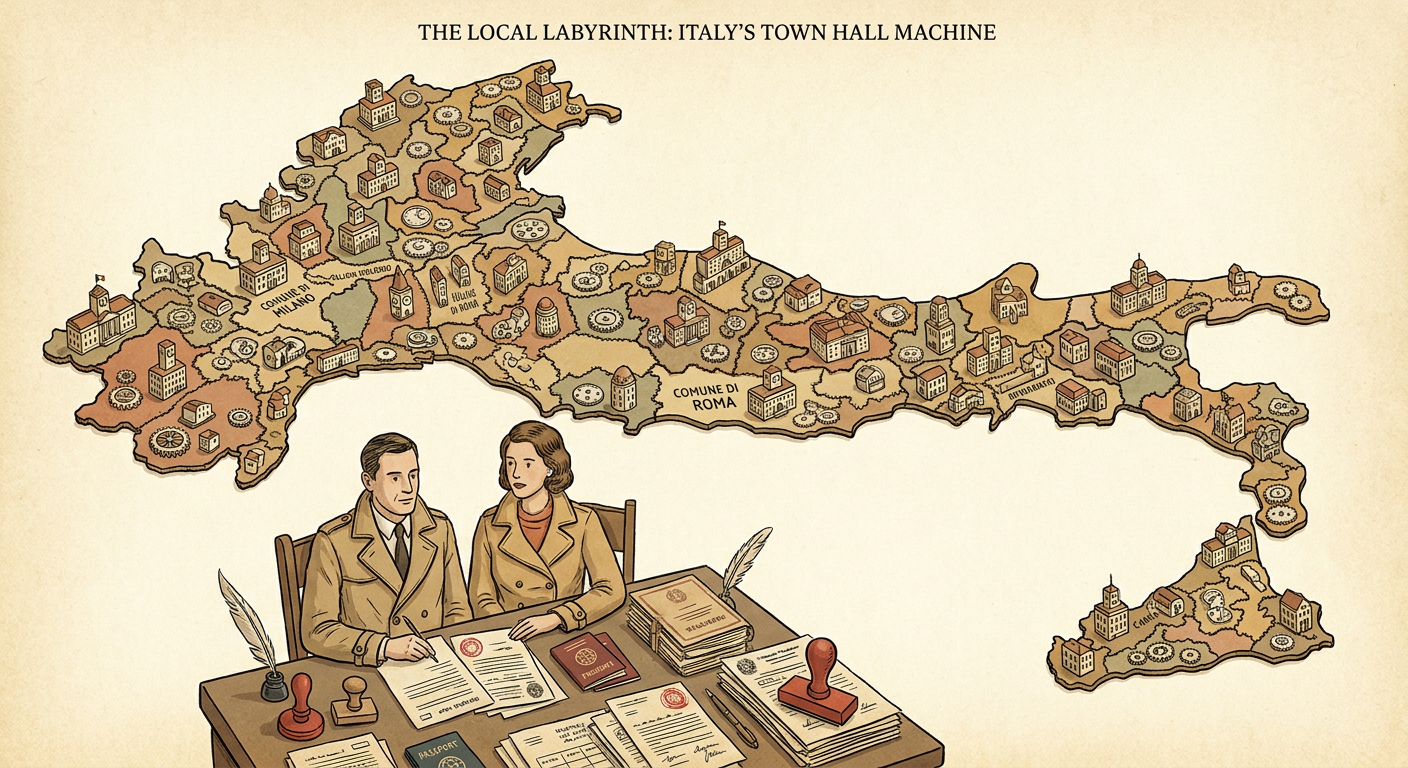
While a visa gets you through the gate, it is the local comune that truly governs your daily life and legal standing in Italy. Beyond the aesthetics of a town, understanding the municipal bureaucracy—from residency registration to local healthcare access—is the real secret to a successful transition. Discover why choosing the right Italian municipality is the most important decision you will make for your new life abroad.
The Comune Runs Your Life in Italy (More Than You Think)
When Americans picture the bureaucracy of moving to Italy, they tend to imagine the obvious parts: the visa appointment at the consulate, the pile of apostilled documents, the sworn translations, the health insurance policy purchased specifically to satisfy an official who may or may not examine it closely. That’s the bureaucracy people prepare for. It’s visible, intimidating, and finite. You can put it in a folder, make a checklist, and eventually, if all goes well, cross it off.
That’s also the easy part.
What catches most people off guard is what comes after. Because once you arrive in Italy, once the visa has done its job and the airport stamp has dried, the bureaucracy doesn’t end. In many ways, it begins. And at the center of that next phase is the one institution almost nobody spends enough time thinking about before they move: the comune.
If you’re American, Canadian, Brit or Aussie, it’s tempting to think of the comune as little more than city hall, an administrative building where paperwork gets filed and forms get stamped. That’s technically true, but it misses the point entirely. In Italy, the comune is far more than a municipal office. It is the local authority that governs the practical mechanics of your life. It is where your residency becomes official, where your household becomes registered, where your address becomes recognized, and where a surprising number of downstream systems begin to function, or fail to.
People often assume that Italy operates as one unified bureaucracy because, after all, it is one country. That assumption lasts right up until they start dealing with local administration.
Italy, in practice, is less like a single machine and more like thousands of semi-independent ecosystems operating under a shared legal framework. National laws exist, certainly, but their implementation often filters through local habits, local interpretations, and local administrative culture. The result is that moving to Italy is not just about moving to Italy. It’s about moving to a specific comune, and that distinction matters more than most newcomers realize.
I’ve seen this firsthand in countless conversations with expats who assumed the hardest part was getting the visa approved. They spend months gathering financial records, proving passive income, securing leases, arranging private health insurance, translating marriage certificates, obtaining apostilles, and navigating consular requirements that often feel designed by Kafka on an espresso binge. When the visa finally comes through, there’s a natural sense of victory. The bottle of wine gets opened. Family gets notified. Social media gets updated with some version of “We did it.”
And to be fair, they did do something significant.
But what they did was unlock the door.
Actually living in Italy, legally and operationally, depends on what happens next. That process quickly runs through the comune.
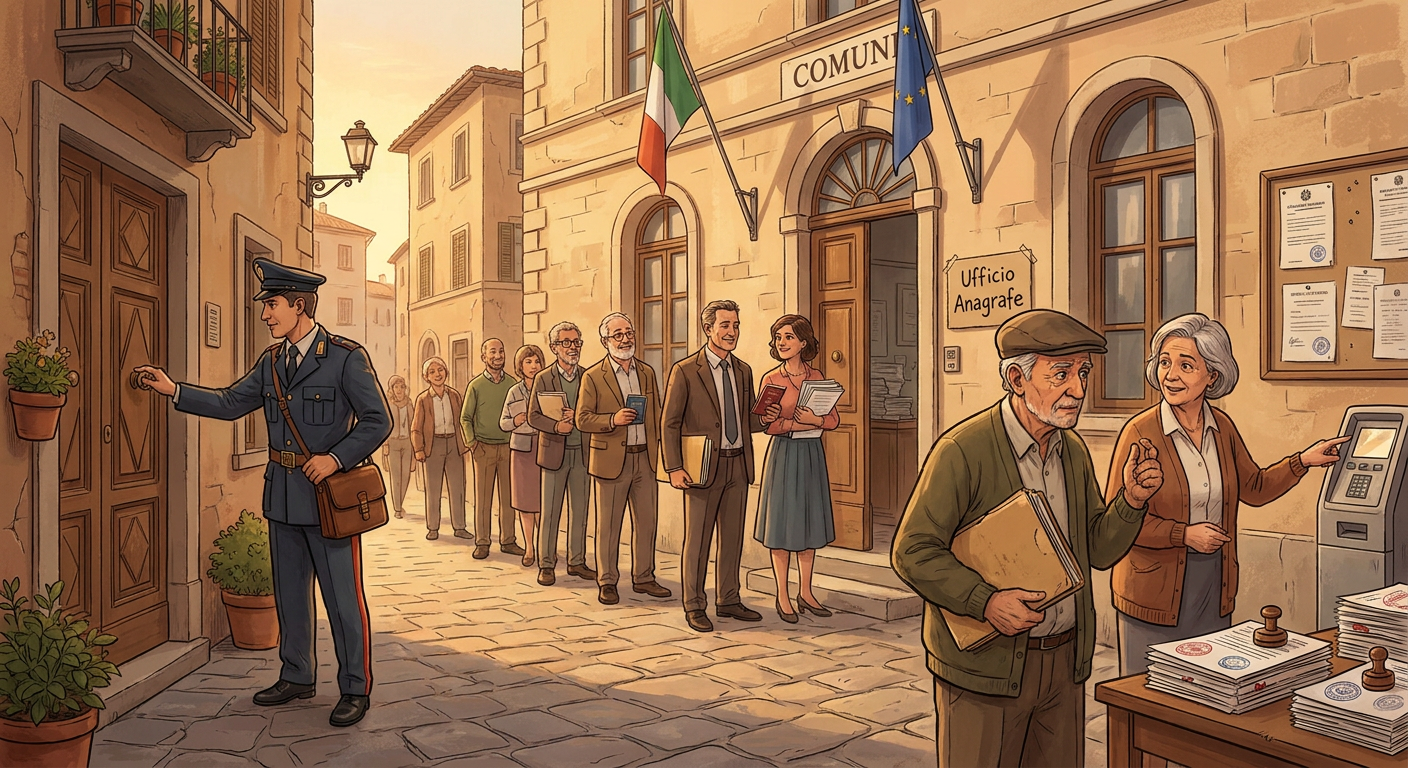
The first major intersection most new arrivals have with the comune is the anagrafe, the municipal registry office. This is where residency gets formalized. Until you register there, you are in a strange administrative gray zone: physically present, legally admitted, but not yet anchored in the local system. Residency registration is what turns your presence into a recognized fact.
That recognition has consequences. It affects healthcare enrollment, identity documents, tax positioning, family registration, and access to local services. It also creates a paper trail that matters far more than many Americans are used to.
In the United States, proving where you live can be casual. A utility bill usually does the trick. In Italy, residence is treated with more formality because it connects to legal rights, taxation, healthcare access, and municipal obligations. The address isn’t just where your Amazon packages go. It’s where the state expects to find you.
And sometimes, quite literally, it checks.
One of the more charmingly unnerving parts of Italian residency registration is the potential visit from the vigile, usually municipal police tasked with verifying that you actually live where you say you live. This is one of those moments where newcomers realize that Italy’s administrative culture has its own logic.
The visit isn’t hostile. It’s procedural. But it does create a layer of real-world consequence to paperwork. I’ve had people ask me whether they can take a weekend trip after filing residency paperwork, whether they can go visit family in another region, or whether being out grocery shopping could create a problem.
And the honest answer is: maybe.
If the officer comes by and nobody is there, it can delay the process. Sometimes they’ll return. Sometimes they’ll leave instructions. Sometimes the timeline stretches because of something as simple as bad timing. There’s a dark comedy to the idea that after spending thousands on international relocation, your residency status can be delayed because you were at Conad buying mozzarella.
But that’s Italy. Bureaucracy here often intersects with ordinary life in very tangible ways.
What makes all this especially challenging for newcomers is the variability. People want rules. Italy offers frameworks.
I once watched two expat couples compare their residency experiences. Same nationality, same visa type, similar documentation, similar timeline. One completed residency registration in under two weeks. The other spent nearly three months bouncing between offices, collecting additional documents, and hearing some version of “next week” often enough to suspect it was less a timeline and more a philosophical concept.
Different comuni.
That was the difference.
This is one of the hardest realities for highly organized people to accept. You can study national law and still be surprised locally. One comune may require only the basics. Another may ask for supplemental declarations, additional translations, or local documentation that wasn’t mentioned anywhere obvious. It’s not always because anyone is wrong. Often it’s simply because local administrative practice fills in the gaps left by broad national frameworks.
That local layer affects more than residency.
Healthcare, for example, is often discussed as if it’s a national switch you simply flip once you arrive. But healthcare enrollment is frequently tied to residency registration, which means delays at the comune can affect your access to the public system. For retirees especially, this matters enormously. Access to a general practitioner, prescriptions, specialist referrals, and local healthcare administration often begins with proving residence.
And then there are the smaller things. The things nobody writes about in dreamy relocation articles.
Waste taxes, for one.
Every property occupant in Italy eventually becomes acquainted with TARI, the municipal waste tax. It’s one of those gloriously unsexy realities of adult life abroad. Nobody fantasizes about understanding trash taxation when imagining retirement under the Mediterranean sun, but the bill comes all the same. The registration process, deadlines, and calculation methods can vary, and if you ignore it, the comune has ways of reminding you.
These details sound small until you stack enough of them together. That’s when you realize the comune isn’t peripheral to your life in Italy. It’s foundational.
This is why I think one of the biggest mistakes people make when scouting towns is focusing entirely on aesthetics.
They fall in love with the piazza, the views, the architecture, the morning cappuccino at the corner bar, and all of that matters. Of course it does. Emotional fit matters. Lifestyle matters.
But administrative fit matters too.
A beautiful town with chaotic municipal systems can make your transition harder than it needs to be. A less glamorous town with organized offices, responsive staff, and smoother administrative processes can dramatically improve your quality of life, especially in the first year.
This isn’t something people like to hear because it sounds unromantic. Nobody wants to choose a town partly because the anagrafe office answers emails.
But after enough experience with Italian bureaucracy, trust me, responsiveness becomes sexy.
That doesn’t mean Italy is broken. In fact, I’d argue the opposite.
What many Americans interpret as inefficiency is often just locality. Italy is deeply local. Systems are rooted in place, shaped by history, and run by people rather than by faceless automation. That can be frustrating when you want predictability, but it also means that over time, the system becomes personal. You learn the rhythm. You learn who handles what. You learn that Maria isn’t ignoring you, Maria is simply on lunch until 3:30, and lunch in Italy remains one of the few institutions more respected than bureaucracy itself.
There’s something strangely grounding in that.
Annoying, occasionally absurd, but human.
And that’s the thing many people miss before they move: relocating to Italy is not simply changing countries. It’s entering a local ecosystem. A town. A municipality. A community structure that governs much of your daily life in ways you won’t fully appreciate until you’re inside it.
The visa gets you through the gate, but the comune determines how your life takes shape once you’re there.
That’s why choosing where to live should never be based solely on beauty, climate, or cost. It should also include an honest assessment of how the place functions. How it processes. How it communicates. How it handles newcomers.
Because in Italy, practical life is local.
And local life begins at the comune.
If you’re planning your move and trying to figure out not just where you want to live, but where you can actually build a functional life with the least administrative friction, that’s exactly the kind of strategy I help clients work through.
The pretty towns are easy to find.
The functional ones take a little more digging.