Rent or Buy in Italy? The Math Most Retirees Never Run
By Caesar Sedek ·

Retiring in Italy often starts with the dream of homeownership, but the financial reality of the Italian property market can tell a different story. Discover why renting may actually be the smarter move for your retirement bridge, long-term flexibility, and peace of mind. This guide breaks down the hidden costs of buying, how long-term leases work, and the math you need to run before trading your savings for stone walls.
If you are planning to retire in Italy, you have already bought a house there in your head. A terrace, shutters, something medieval in the middle distance. I have done it many times.
We are moving to Italy in 2030. We are not buying. We are renting long term, on purpose, and the decision came down to three things: what our housing money is actually for, what the round trip on an Italian apartment really costs, and the fact that we have no idea which country our daughters will live in by 2042.
Here is the whole reasoning, including the arithmetic, how Italian leases actually work, and the cases where buying is the better call. Because for plenty of people it is.
Is your housing money spare cash, or is it what you live on?
This is the question that settles most of it, and almost nobody asks it first.
When we move, we sell the house in California. That equity is not a down payment waiting to happen. It is our bridge: the money we live on between the day we stop working and the day the retirement accounts and Social Security take over.
So the question was never whether we could afford an apartment in Italy. It was whether we wanted to take the money we are supposed to live on for the next ten years and turn it into walls. Walls are lovely. You cannot buy groceries with them.
And once the bridge is inside the apartment, the only way to get it back out is to sell the apartment. Which brings us to the part the property listings leave out.
What does it cost to buy and sell a house in Italy?
A simplified example, not a quote. Say a €300,000 apartment bought as your main home.
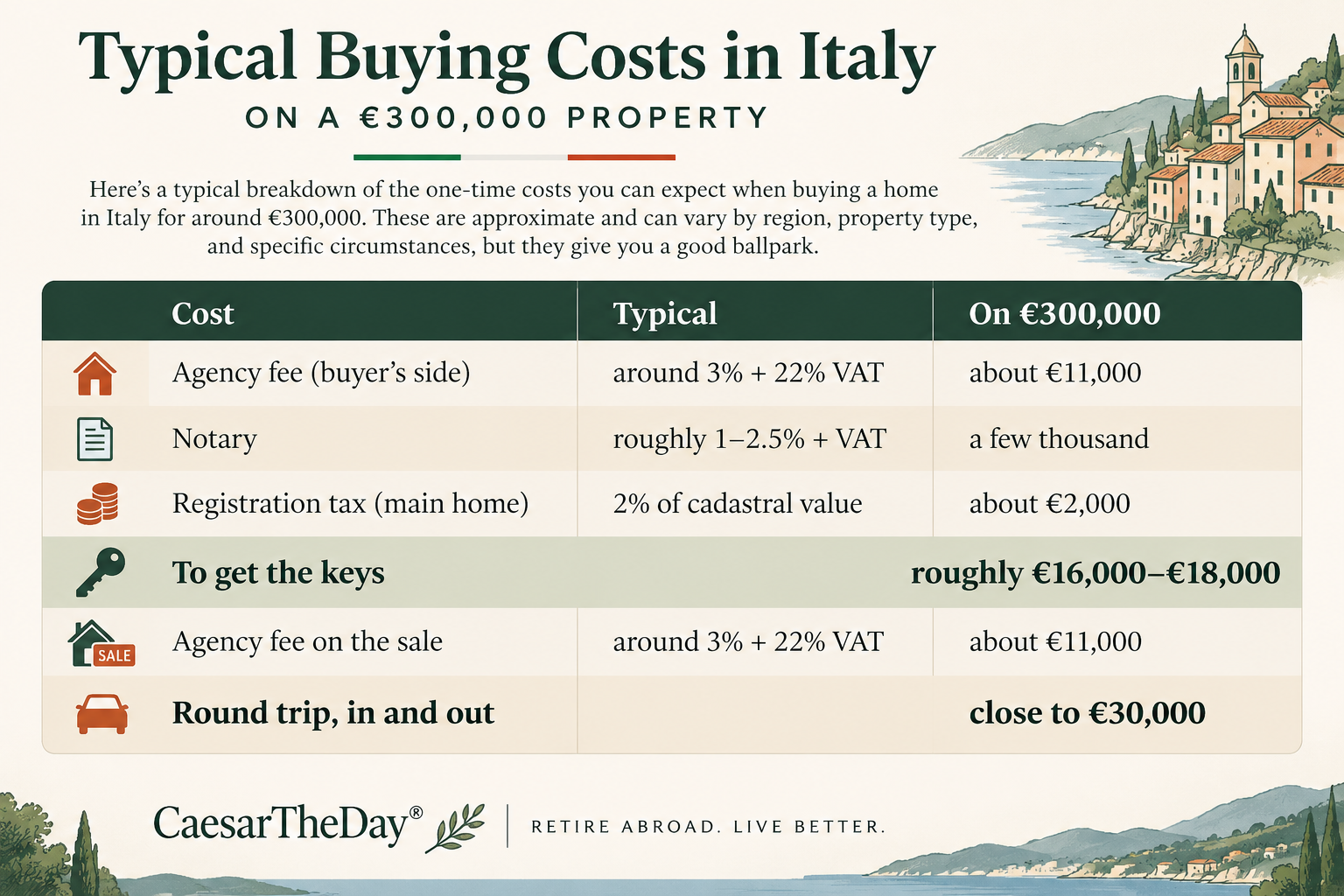
At €1,300 a month, that round trip is almost two years of rent, spent on commissions and stamps before the market has done anything at all.
Then there is the money itself. If that €300,000 stays invested and earns 4%, which is an example and not a promise, that is about €12,000 a year. Rent at €1,300 a month is €15,600 a year. In that example, the money you did not spend on the apartment pays most of the rent on the apartment.
Fees vary by property, agency and region. Registration tax on a second home is 9% rather than 2%. Run your own numbers with a professional before you lean on any of this.
Is Italian property a good investment?
Americans grow up being told the house is the retirement plan. In Italy it often is not.
By 2019, Istat had prices for existing homes roughly 17% below where they were in 2010. They have been recovering since, up 4.7% last year. That is a market that has spent more than a decade getting back to where it started, not one where you sit on the balcony for eight years and walk away wealthy.
And outside the big cities and the towns everyone posts on Instagram, selling can take a while. A quiet coastal town in February is lovely to live in. It is not where buyers line up around the block. If you need your money back on a particular date, a small-town apartment is a poor place to keep it.
Isn’t renting just throwing money away?
Every uncle at every family party believes this. But owning is not free either.
As an owner you pay the spese condominiali, the condominium fees, plus the repairs, the facade, and the boiler that waits for the first cold week of January to retire before you do. In an Italian rental, extraordinary maintenance is generally the landlord’s responsibility and ordinary upkeep is yours. The roof is not your problem.
Renting is not throwing money away. It is paying for a place to live and for the right to leave. When you are sixty and you do not know which country your children will settle in, that right is worth real money.
For us it is the kids. Our older daughter is in college and our younger one finishes high school around the time we move. If we rent and want to be closer to either of them, that is a notice letter and a moving van. If we own a flat in a small Ligurian town, it is a listing, a buyer who may or may not appear, and a long stretch of phone calls with a geometra, the surveyor who handles property paperwork in Italy.
It is also us. Our 2030 apartment may not be our 2042 apartment. At some point the sea view will matter less than the elevator and the distance to the hospital. Renting lets the home change when we do.
How do long-term rentals in Italy actually work?
If renting is the plan, it has to be a real plan. Italian residential leases are governed by Law 431/1998, and three types matter.
The 4+4, or canone libero. Four years, then it renews for another four almost automatically. Rent is set freely between the parties. At that first renewal the landlord can refuse only on the statutory grounds, such as moving in themselves or selling, and must notify you in writing at least six months ahead.
The 3+2, or canone concordato. Three years plus two, with rent set inside locally agreed bands. Often cheaper, and it carries tax advantages for the landlord, which is why some will push you toward it.
The transitorio. One to eighteen months, for a documented temporary need. Useful for landing. Not a way to live.
As a tenant you can withdraw early for serious reasons with six months’ notice, and many contracts let you leave at any time with that same notice. Look for that clause and ask for it if it is not there.
Two more things. The lease has to be registered with the Agenzia delle Entrate, the Italian tax office, and a registered lease is what lets you register residency with your comune. If you are applying for an Elective Residency Visa, your consulate will want to see accommodation documented, though what satisfies them varies from one consulate to the next.
And the honest catch: after eight years, either side can end the arrangement with six months’ notice, and the landlord does not have to give a reason. Long-term renting in Italy is not forever. It is eight years at a time.
What to check before you sign a lease
The exit clause. Can you leave at any time with six months’ notice, or only for serious reasons?
Which contract type it is, and whether the rent fits the local concordato bands if that is what it claims to be.
That the landlord will register the lease, and when. Residency depends on it.
Who pays for what. Extraordinary repairs, condominium fees, and heating should all be written down.
The building’s climate zone and heating months, the last winter’s actual bills, and whether the place faces south. Also worth checking the noise, which deserves its own visit at several times of day.
When does buying in Italy make sense?
Buying can absolutely be the right call. It tends to be when all of these are true:
You know the town well, in every season, not just in June.
The money is not what you are living on.
You are staying put, and family is near.
You have run the numbers with a professional and you want your own front door.
Some people also love restoring a place, and that is a real pleasure that no spreadsheet captures. If you go that way, get a notary involved from the start and have a geometra confirm the property is legally what the listing says it is, before you sign anything rather than after you have fallen in love with the balcony. For the wider picture of what the first year abroad actually costs, the hidden costs of retiring to Italy covers the rest of it.
FAQ
Is it cheaper to rent or buy in Italy? Over a long enough period, owning usually wins on monthly cost. Over five to eight years, the roughly €30,000 round trip on a €300,000 apartment plus what your capital could have earned elsewhere often puts renting ahead. The honest answer depends on how long you will stay and what the money would otherwise be doing.
Can Americans buy property in Italy? Yes. There is no residency requirement for Americans buying Italian property, and buying a house does not give you the right to live there. Residency comes from a visa and a permesso, not a deed.
What is a 4+4 lease? The standard Italian long-term residential lease: four years, renewing for four more. The landlord can refuse the first renewal only on grounds set by law, in writing, six months ahead.
Do I need a registered lease for the Elective Residency Visa? Consulates expect you to document where you will live, and a registered lease is the cleanest way to do it. Requirements differ by consulate, so check the one covering your state before you commit to anything.
How long does it take to sell a house in Italy? It depends entirely on where. In cities and sought-after areas, reasonably quickly. In a quiet small town off-season, it can take a long time, and the discount to get it done can be real.
Your move
Work out what your housing money is for. Run your own rent-or-buy math, both directions. Find out what a 4+4 actually rents for in your town, not the holiday price. Then do not buy anything you have not lived near through a winter.
I still want the balcony. I am just going to rent it.
Grab a Free Renting in Italy Guide
Disclaimer: Simplified examples only. Fees, taxes and rules vary by property, region and comune, and they change. I am not a lawyer or a tax adviser. Get a notary and a geometra involved before you sign anything, and a commercialista before you make tax assumptions.
Sources: idealista.it/en/news, costs of buying property in Italy (January 2026) · ANSA/Istat, house prices down 17.2% since 2010 (July 2019) · Istat, Prezzi delle abitazioni Q4 2025 · Banca d’Italia, Sondaggio congiunturale sul mercato delle abitazioni Q2 2026 · Law 431/1998 arts. 2–3 · Agenzia delle Entrate on lease registration.