Italy Retirement Visa (ERV): Why Your Consulate Decides
By Caesar Sedek ·
Navigating the Italy elective residency visa requires understanding that your local consulate, not the internet, holds the final authority on requirements. This guide breaks down current income thresholds, essential documentation, and the nuances of the application process to help you present a flawless packet and secure your Italian dream.
The Italy retirement visa, officially the elective residency visa (ERV), is decided by the Italian consulate that covers where you legally live. Not by a Facebook group, a Reddit thread or a blog post from 2018. Each consulate sets its own requirements, wording and format, which is why every checklist you find online disagrees with the next one. This post covers what consulates mostly agree on, where they differ, and how to hand over your packet so it reads complete.
What is the Italy retirement visa?
The elective residency visa is for non-EU nationals who can support themselves from stable passive income: pensions, Social Security, annuities, rental and investment income. It does not allow you to work in Italy. If you want to work, that is a different visa.
You apply at an Italian consulate before you go, at the consulate that covers where you legally live. A U.S. or Canadian citizen permanently and legally living in London applies through the London consulate. The visa gets you in. After you arrive, you apply for the permesso di soggiorno (residence permit) within 8 working days. The visa is the first gate, not the finish line.
Why does every ERV checklist online disagree?
Because they are each right about one consulate at one moment. The member who applied in 2015, the one who applied in 2018, and the one who applied last spring were all describing their own experience. Some consulates publish requirements clearly, some bury them in a PDF, and some do not publish them at all.
In January 2026, I emailed every Italian consulate in the United States and Canada with the same question. Most of the answers lined up. One did not. Facebook groups are good for real stories and encouragement. For a requirement, ask the consulate.
How much income does the ERV require?
As of January 2026, the consulates told me about €31,000 a year per applicant in dependable passive income. That is per applicant, not per household. Consulates call it a minimum, and more income improves your odds. They assess income, not your bank balance, so savings and lines of credit are not income, and neither is work income.
A fictional household with illustrative figures: Alex has a pension and Social Security. Jamie has no income. Two applicants at €31,000 is €62,000, and Alex can carry the whole amount with a signed statement that Alex supports Jamie. Minor children usually add about 5%, so one child brings it to roughly €65,000.
Vancouver is the exception I found. It still applies the older formula, with an extra 20% for a spouse, applied after tax (about CAD 50,200 for one applicant at its January 2026 rate), and it pre-screens every applicant by email before an appointment can be booked. That older formula still circulates in search results and old posts, and it asks far less of a couple than the figure above. A July 2025 Rome administrative court ruling pointed to a lower figure for additional family members, but the consulates' January 2026 replies did not reflect it. These figures are older than six months, so confirm yours. For the full breakdown, read How Much Passive Income Do You Really Need for Italy's Elective Residency Visa?.
What documents do consulates usually ask for?
The list almost every consulate asks for has seven parts: the national visa application form, passport and photos; proof of income, such as award letters, annuity contracts, leases, investment statements and recent tax returns; housing in Italy, generally a 12-month lease or ownership; health insurance that covers you in Italy; marriage and birth certificates for family members, apostilled and translated where required; proof you live in the consulate's jurisdiction; and the fee plus your appointment confirmation.
Housing has to be in place before the consulate says yes, which surprises people who expect it to come after. The differences between consulates are where applications stall. Our Ultimate Document Checklist goes item by item.
How do you get a consulate appointment?
Appointments go through a portal called Prenot@mi. Slots release at set times and can disappear in minutes, sometimes seconds, so checking now and then does not work. Usually you are looking at about six months out, though it varies by consulate. I wrote up what I have learned from feedback and testing in how to improve your chances of landing an appointment.
How should you present your ERV packet?
Order it exactly the way your consulate's checklist is ordered, not the order that makes sense to you. Make the figures match across every document, because an award letter that says one number and a cover letter that says another creates a question nobody needed to ask. Show income in dollars and euros and say which exchange rate you used. Add a short cover letter covering who is applying, the income sources and the housing, plus the spousal support statement if one spouse carries the income. Have translations, apostilles, originals and copies ready in whatever form your consulate asks for.
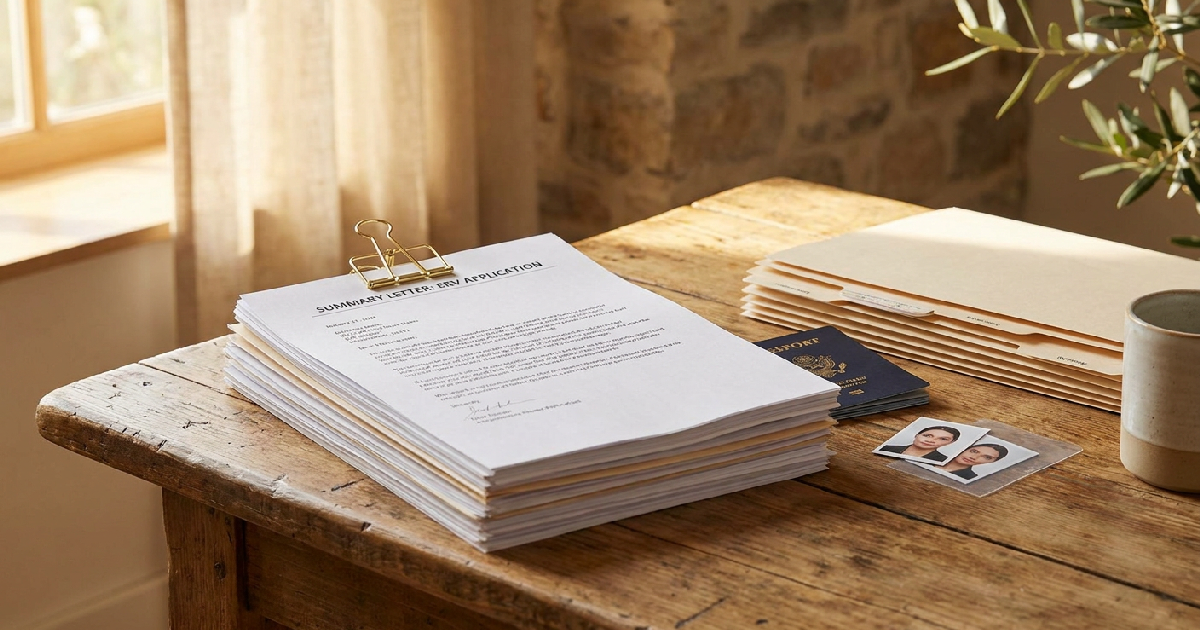
Keep it simple: everything in order, held with one large binder clip, in an accordion file with a sticky note on each section. A complete packet presented badly reads like an incomplete one. This is the same logic as Italy Doesn't Evaluate People. It Evaluates Paper States.
What should you do first?
Now: find your consulate's current ERV instructions, download them and write today's date on them. If anything is unclear, email the consulate. Next: if you are 6–18 months from applying, start the free 14-day Visto Facile trial (no card needed). It loads the requirements for your consulate and shows where each came from. Visto Facile is my product. Not yet: do not gather documents years early. Knowledge has a long shelf life. Documents do not. For timing, see How Long It Really Takes to Move to Italy, and for what happens after you land, The Permesso Receipt Myth.
FAQ
Can I work in Italy on the elective residency visa? No. It is for people supported by passive income.
Can one spouse's income cover both of us? At the consulates I emailed, yes: one spouse can carry the full amount with a statement that they support the other. Each applicant still counts at about €31,000 as of January 2026, so a couple needs about €62,000.
Do savings count as income? Consulates assess income, not just your bank balance. Ask your consulate how it treats investment income and withdrawals.
Do I apply from Italy? No. You apply at the Italian consulate that covers where you legally live, before you go.
Is the visa the same as residency? No. After you arrive you apply for the permesso di soggiorno within 8 working days.
Official sources to cite: your consulate's own published ERV instructions; Prenot@mi; Agenzia delle Entrate.
I'm not a lawyer or tax adviser. This is education, not personal advice. Have qualified professionals check your situation, ideally professionals who understand both countries. Consulates, Questure and comuni interpret rules differently, so check your own consulate's current instructions.