Retiring in Italy on Social Security? Time to Stress-Test the Dream
By Caesar Sedek ·
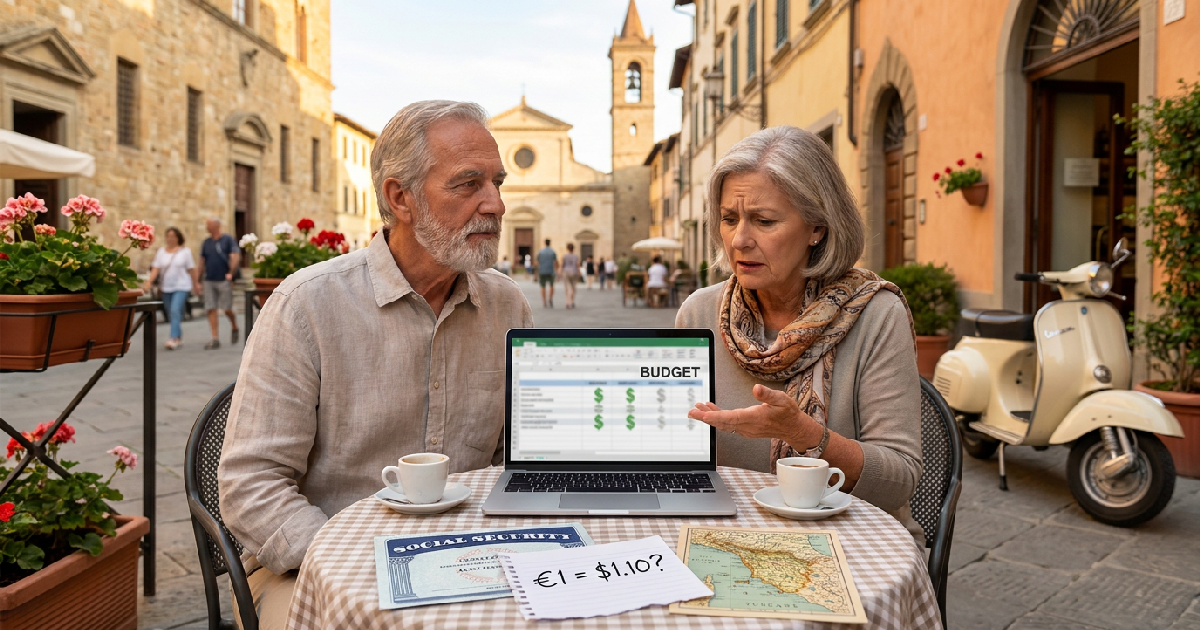
Retiring in Italy is a dream for many, but the latest Social Security projections suggest it is time to stress-test your financial assumptions. This guide explores how potential benefit cuts and currency fluctuations could impact your elective residency visa and long-term budget abroad. Learn how to move beyond the fantasy and build a resilient retirement plan that survives political uncertainty and economic shifts.
Social Security, Italy, and the Retirement Math Nobody Wants to Recalculate
There is a particular kind of American retirement fantasy that goes something like this:
Move to Italy.
Rent or buy something charming but not insane.
Drink coffee in a piazza.
Use Social Security as the dependable monthly floor.
Let the rest of the portfolio breathe.
It is a perfectly reasonable plan.
Which, naturally, means American politics has found a way to make it feel slightly radioactive.
The latest Social Security Trustees Report is not a reason to panic. Panic is rarely useful unless there is a bear, a fire, or an Italian rental agent saying “don’t worry, the lease registration is optional.”
But it is a reason to pay attention.
According to the 2026 Trustees summary, the Old-Age and Survivors Insurance Trust Fund, the part of Social Security that pays retirement and survivor benefits, is projected to pay full scheduled benefits until the fourth quarter of 2032 (so two years before my 62nd birthday). After that, if Congress does nothing (which is almost guaranteed), continuing income would cover about 78% of scheduled benefits. In normal human language: a possible 22% cut to retirement benefits if lawmakers fail to act. The combined Social Security funds are projected to last until the third quarter of 2034 (age at which I should be eligible for SS), at which point they could pay about 83% of scheduled benefits. Medicare’s Hospital Insurance Trust Fund is projected to reach depletion in the second quarter of 2033, with 89% of scheduled benefits payable at that point.
That is not “Social Security disappears.” That is the lazy Facebook version.
It means the current structure cannot pay everything promised forever without changes. Those changes could come as higher taxes, benefit formula changes, delayed retirement ages, means testing, increased wage caps, Medicare changes, or some politically tortured mixture of all of the above. Because apparently running a country is now just waiting until the dishwasher floods the kitchen and then arguing over whether water is real.
For Americans planning to retire in Italy, this matters.
A lot.
Social Security Is Not a Bonus. It Is the Floor.
For many Americans applying for Italy’s elective residency visa, Social Security is not just “nice to have.” It is often the core of the passive income case.
The Italian elective residency visa is built around the idea that you can support yourself without working in Italy. Retirees often use Social Security, pensions, annuities, investment income, rental income, and other passive income to show they meet the financial requirement.
So when people say, “Well, Social Security might be reduced someday,” that is not some abstract policy debate for retirees abroad.
It can affect:
Whether you qualify for the visa in the first place.
Whether your income still looks strong at renewal.
Whether your budget works after rent, healthcare, utilities, food, transportation, travel, taxes, and the mysterious €400 you somehow spent at Conad.
Whether you can stay in your chosen town or need to move somewhere cheaper.
Whether “retirement in Italy” means a comfortable life or a permanent spreadsheet hostage situation.
And for those already living in Italy, the risk is different but still real. You may already have the visa, the permesso, the apartment, the routine, the butcher who now recognizes you, the barista who knows your coffee order, and the deep emotional trauma of dealing with Poste Italiane.
But if your monthly income drops by 10%, 15%, or 22%, the math changes.
Not necessarily catastrophically. But enough.
A 22% Cut Does Not Hit Everyone the Same Way
Let’s say someone receives $3,000 per month from Social Security.
A 22% cut would reduce that by $660 per month.
That is $7,920 per year.
In Italy, that could be the difference between:
A better apartment and a compromised one.
A coastal town and an inland town.
A car and no car.
Private health flexibility and white-knuckling every decision.
Regular travel back to the U.S. and “maybe next year.”
A comfortable retirement and a retirement that technically works but feels like punishment with better cheese.
Now imagine a couple relying heavily on two Social Security checks. Or worse, one larger check and one smaller spousal benefit. A cut does not just reduce income. It reduces margin.
And margin is what makes living abroad feel like freedom instead of a beautiful administrative trap.
Italy Makes the Math Better, But It Does Not Make Math Disappear
One reason Italy attracts American retirees is that the cost of living can be lower than many parts of the United States.
Can be.
That phrase is doing a lot of work.
Italy is not one price. Milan is not Molise. Florence is not inland Abruzzo. Liguria is not Calabria. A sea-view apartment in a desirable town is not the same thing as a house in a village where the most exciting local amenity is a bench and three men judging your parking.
If your Social Security is stable, Italy can be a very smart retirement move. But if your plan only works because every dollar arrives exactly as projected, every year, forever, with no policy changes, no exchange-rate weirdness, no rent increase, no healthcare surprises, no family emergencies, and no inflation, then what you have is not a retirement plan.
It is a hostage note written in Excel.
The Exchange Rate Problem
Americans retiring in Italy usually receive Social Security in dollars and spend in euros.
That means your lifestyle is exposed to the dollar/euro exchange rate.
When the dollar is strong, life feels easier. Your Social Security stretches further. Dinner tastes better. The Aperol spritz has a faint note of financial smugness.
When the dollar weakens, your income effectively shrinks.
And this is not theoretical. The dollar has recently been weak by recent standards against the euro, with one dollar converting to roughly €0.86–€0.87. That means a $3,000 monthly Social Security benefit becomes only about €2,580 to €2,610 before any bank fees, transfer costs, taxes, or spending friction.
Now compare that to a stronger-dollar scenario where one dollar buys closer to €1.00. That same $3,000 benefit would feel like €3,000. The difference is roughly €390 to €420 per month, or about €4,700 to €5,000 per year. That is a real lifestyle hit. That is not “skip one cappuccino” money. That is rent pressure, healthcare buffer, travel budget, car expense, or “maybe we are not living in that coastal town after all” money.
So even before we talk about potential Social Security cuts, retirement age changes, or Medicare cost pressure, Americans abroad already face currency risk.
A future retiree using Social Security as the main passive income source should not ask only:
“Do I qualify today?”
They should ask:
"Would I still be okay if my Social Security benefit were cut by 15% and the dollar-to-euro conversion gave me another 10% to 15% haircut?"
That is the real planning question.
Annoying? Yes.
Necessary? Also yes.
Medicare Matters Even If You Live in Italy
A lot of Americans moving to Italy misunderstand Medicare.
Medicare generally does not cover routine care outside the United States. Italy has its own healthcare system, and depending on your residency status, region, and situation, you may use public healthcare, private coverage, or some combination.
But Medicare still matters.
Why?
Because many Americans keep Medicare Part B as a fallback in case they return to the U.S., split time, or need treatment stateside. Part B premiums can rise. Medicare policy can change. The Trustees summary notes that Supplementary Medical Insurance, which includes Part B and Part D, is financed differently because premiums and federal contributions are adjusted each year, but rising SMI costs place increasing demands on beneficiaries and taxpayers.
Translation: it does not “run out” the same way, but the costs can still land in your lap.
So for Italy retirees, the healthcare question is not simply:
“Is Italian healthcare cheaper?”
Often, yes.
The better question is:
“What is my total healthcare strategy across Italy and the U.S.?”
That includes Italian access, private insurance if needed, Medicare decisions, travel coverage, prescription costs, and whether you are planning to return to the U.S. for certain care.
This is where retirement planning gets boring.
Unfortunately, boring is where the landmines are buried.
About That Word “Entitlement”
Now let’s deal with the word that makes my eye twitch.
“Entitlements.”
Politicians, especially Republicans, love using that word when talking about Social Security and Medicare. It is a neat little rhetorical trick. Say “entitlement” enough times and suddenly people start hearing “handout.”
But Social Security is not a gift from a benevolent Congress.
It is not free money.
It is not a coupon they found under a couch cushion and generously decided to mail to grandma.
Workers paid into this system. Employers paid into this system. Self-employed people paid both sides into this system. In 2026, Social Security payroll taxes apply to earnings up to $184,500, with employees and employers each paying 6.2%, and self-employed workers paying 12.4%.
I have worked for 30 years. I have paid into Social Security for 30 years. For many of those years, I contributed the maximum amount allowed.
So no, I am not “entitled” in the sneering, lazy, cable-news sense of the word.
I am entitled in the contractual sense.
I paid in.
I expect the system to pay out.
That is not greed. That is not dependency. That is not some decadent retiree fantasy where I lounge in Italy demanding tribute from the Treasury while eating carbonara.
That is the bargain.
And if politicians want to change the bargain after decades of taking the money, they should at least have the basic decency to say that plainly instead of dressing it up in think-tank language and pretending retirees are the fiscal problem.
They are not.
The problem is political cowardice wrapped in actuarial charts.
What This Means for People Already Retired in Italy
If you are already in Italy and receiving Social Security, do not panic-pack your apartment.
But do stress-test your life.
Run your budget with a 10%, 15%, and 22% reduction in Social Security.
Look at your rent or mortgage first. Housing is the big lever. If your housing cost is too high, everything else becomes fragile.
Then look at healthcare, transportation, travel back to the U.S., food, utilities, insurance, and taxes.
If you are living in a higher-cost region, ask yourself whether you have a Plan B town or region. That does not mean you need to move. It means you should know where you would move if the math changed.
Abruzzo, Molise, parts of Puglia, inland Marche, Calabria, Basilicata, Sicily, and Sardinia may all enter the conversation depending on your lifestyle tolerance, healthcare needs, airport access, and desire to not live somewhere that feels like a punishment invented by a medieval accountant.
Also, keep more cash reserve than you think you need.
Italy is wonderful, but it is not frictionless. Bureaucracy has a way of turning small problems into full-body workouts.
What This Means for People Planning to Retire in Italy
If you are still in the planning stage, good. You have time.
Do not build your Italy plan around the rosiest version of your Social Security estimate.
Build three versions:
The promised benefit.
The reduced benefit.
The delayed or politically altered benefit.
If your entire plan collapses under a 15% reduction, do not ignore that. Fix the plan now.
That might mean retiring later, choosing a less expensive region, keeping more investment income outside Social Security, reducing debt before leaving, downsizing harder, delaying a home purchase in Italy, or avoiding a lifestyle that depends on a perfect exchange rate.
And for elective residency visa applicants, this is especially important. If Social Security is your main passive income source, you need to think carefully about how strong your income picture looks not only on application day, but at renewal and after.
The goal is not to squeak by.
The goal is to create a plan that survives contact with reality.
Reality, annoyingly, keeps showing up.
The Retirement Abroad Rule: Don’t Rely on One Pillar
For Americans retiring in Italy, Social Security should be treated as one pillar.
A major pillar, yes.
But not the whole building.
A stronger Italy retirement plan has multiple supports:
Social Security.
Pensions, if you have them.
IRA or 401(k) withdrawals.
Taxable brokerage income.
Cash reserves.
A realistic housing plan.
A healthcare strategy.
A currency buffer.
A tax plan that understands both the U.S. and Italy.
A Plan B region or town if costs rise.
This is not doom-and-gloom. It is adult planning.
Deeply irritating, yes. But adult.
The Italy Dream Is Still Viable
Here is the part I do not want people to miss.
The uncertainty around Social Security does not mean retiring in Italy is a bad idea.
For many Americans, Italy may still be safer, cheaper, healthier, and more humane than trying to age in the United States, where one medical bill, rent increase, insurance premium, or property tax reassessment can walk into your life like a drunk raccoon with a flamethrower.
But the Italy plan has to be built honestly.
Not on vibes.
Not on Facebook anecdotes.
Not on “my cousin moved to Tuscany in 1998 and bought a farmhouse for seventeen dollars.”
And definitely not on the assumption that Washington will behave responsibly before the last possible second.
Because history suggests Washington will first hold hearings, blame immigrants, terrify retirees, invoke “entitlements,” fundraise off the panic, and then maybe do something useful after everyone’s blood pressure has become a UNESCO heritage site.
My Advice
If you are planning to retire in Italy and Social Security is a key part of your income, do this now:
Run your retirement budget with a 22% Social Security haircut.
Run it again with a weaker dollar.
Run it again with higher healthcare costs.
Then ask the only question that matters:
“Does this still work?”
If yes, good. Keep going.
If no, do not abandon the dream. Adjust the architecture.
Maybe the answer is a different region. Maybe it is renting before buying. Maybe it is delaying retirement by a year or two. Maybe it is building a stronger investment bridge. Maybe it is keeping the U.S. house a little longer. Maybe it is choosing Molise over Liguria, which is not a sentence most people expect to say out loud, but here we are.
The point is not to be scared.
The point is to stop pretending the numbers are fixed.
Social Security is not charity. It is not a handout. It is not a political favor. It is money workers paid into a system with the expectation that the system would be there when they needed it.
If lawmakers want to protect it, good.
If they want to change it, they need to say exactly who pays, who loses, and why.
And if they keep calling it an “entitlement” like retirees are standing around demanding free cannoli from the government, they can kindly go pound sand.
Preferably somewhere with no shade and poor public transportation.
Planning your own move to Italy?
Planning your own move to Italy?
Do not build your retirement plan on hope, vibes, and Facebook folklore. Start with the numbers, the documents, and the actual visa requirements before you sell the house, book the flight, and discover that “passive income” means something very specific when a consulate is staring at your packet.
My Italy planning tools, regional guides, and visa resources are built to help you stress-test the move before reality walks in wearing sensible shoes.
Explore the Italy regional guides at italy.caesartheday.com.
And if you are applying for the Italian elective residency visa, check out Visto Facile, my ERV visa navigator built to help you track consulate-specific requirements, organize your documents, manage your timeline, and keep your application from turning into a paper-based crime scene.
Start here: vistofacile.caesartheday.com
Visit CaesarTheDay.com for books, articles, services, and planning resources.
Sources & Further Reading
Social Security Administration, 2026 Trustees Report Summary
https://www.ssa.gov/oact/trsum/Social Security Administration, 2026 Trustees Report Press Release
https://www.ssa.gov/news/press/releases/2026/#6-2026-1Social Security Administration, Contribution and Benefit Base
https://www.ssa.gov/oact/cola/cbb.htmlSocial Security Administration, Maximum Taxable Earnings FAQ
https://www.ssa.gov/faqs/en/questions/KA-02387.htmlMedicare.gov, Travel Outside the U.S.
https://www.medicare.gov/coverage/travel-outside-the-u.s.Social Security Administration, Payments Outside the United States
https://www.ssa.gov/international/payments.htmlNational Committee to Preserve Social Security and Medicare, Making Sense of the New Social Security Trustees Report
https://www.ncpssm.org/entitledtoknow/making-sense-of-the-new-social-security-trustees-report/TIME, Social Security, Retirement, Medicare, Disability Fund
https://time.com/article/2026/06/10/social-security-retirement-medicare-disability-fund-trump/MSNBC / MaddowBlog, Speaker Johnson Eyes a New Plan for Social Security and Medicare to Be Shared in 2027
https://www.ms.now/rachel-maddow-show/maddowblog/speaker-johnson-eyes-a-new-plan-for-social-security-and-medicare-to-be-shared-in-2027